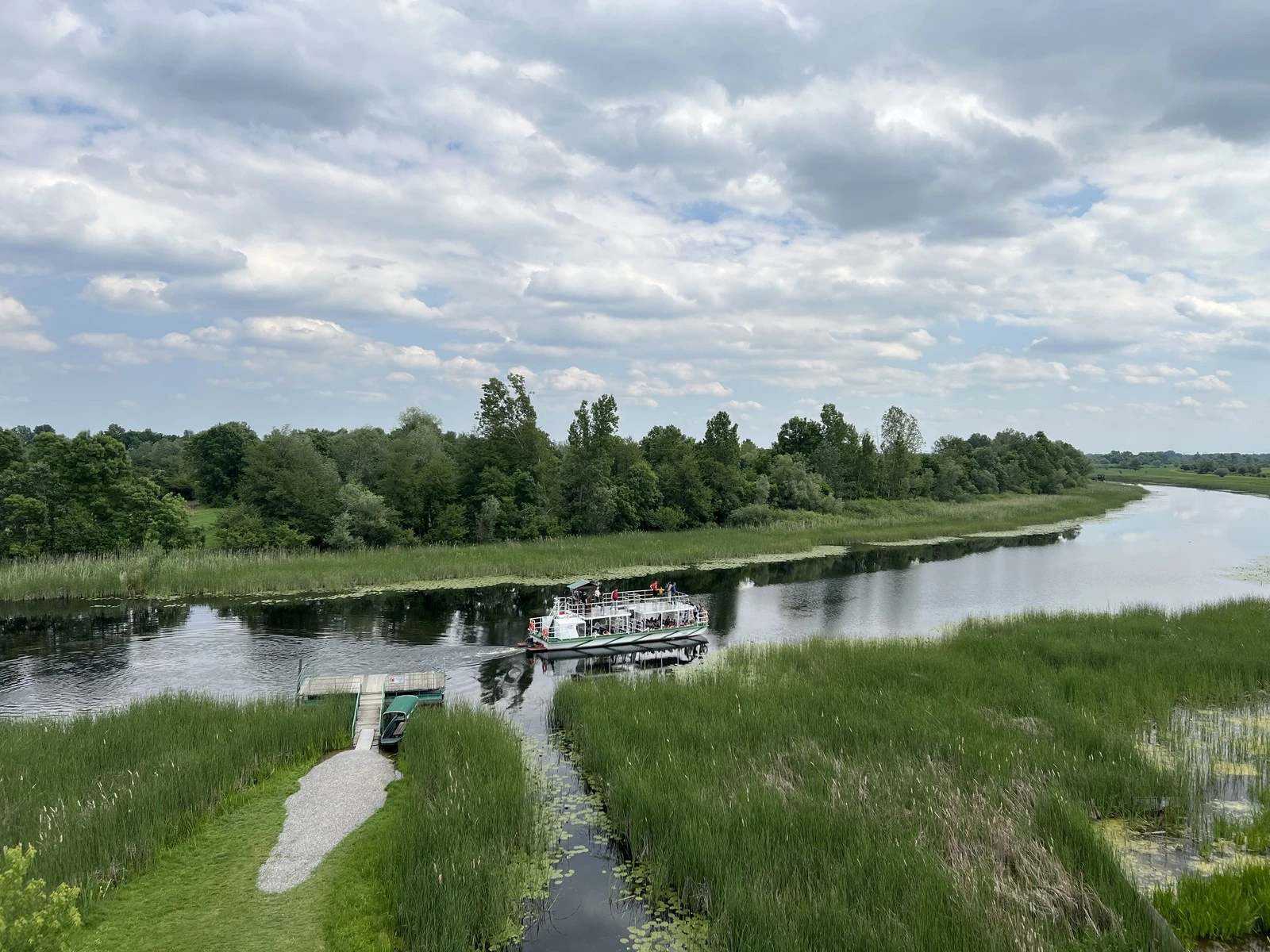
The Zasavica Special Nature Reserve is one of the most important protected wetland areas in Serbia, known for its rich flora and fauna, as well as rare plant and animal species.

Get to know invasive alien plants – the genus Reynoutria

The genus Reynoutria includes perennial herbaceous plants with a strong rhizome. Shoots develop from these rhizomes, which can be over 3 m tall and about 4 cm thick. The stems are upright, hollow, and leafless at the base. The leaves are large, broad, elongated, and oval. The flowers are arranged in panicles 8 to 12 cm long. A single plant can have around 200,000 flowers. The root penetrates to a depth of 1 to 2 m and spreads. This isA common description for several taxa within this group, which are strikingly similar and to which very similar eradication methods are applied. This genus includes: Reynoutria japonica Houtt., Reynoutria sachalinensis (F.S. Petrop.) Nakai and T. Mori and their spontaneous and fertile hybrid Reynoutria x bohemica Chrtek et Chrtkova. Reynoutria sachalinensis (F.S. Petrop.) Nakai and T. Mori grows up to 5 m in height. These plants originate fromEast Asia.
Plants of the genus Reynoutria were introduced to Europe as ornamental plants in the 19th century. It is assumed that only one plant was introduced to Europe. Later, through vegetative propagation, it spread to many European countries. These plants occupy lawns, wetlands and periodically flooded areas, the banks of streams and standing water bodies, the edges of clearings and roads, and urban areas. They thrive in areas where they arefertilizers rich in nitrogen were used. They cause economic damage, as they reduce the accessibility of areas, hinder the runoff of floodwaters, increase the costs of maintaining watercourses, damage infrastructure (e.g., roots growing under roads), etc.
Impact on living beings:
Allelopathy – they release substances into the soil that inhibit the growth of other plants by affecting the microorganisms living in the soil. In this way, they indirectly cause the extinction of some native species.
Competition – since they start germinating early and grow very quickly, they overshadow other plants, using nutrients from the soil faster and more efficiently. Over time, this leads to the complete inhibition of germination and growth of all other plant species.
Herbivores – It has been noted that in the United Kingdom, sheep, cows, goats, horses and donkeys have fed on the above-ground parts of plants.
Negative impacts on biodiversity:
These plants form almost homogeneous stands in which other species rarely appear. They strongly inhibit the natural process of regrowth and renewal, i.e., natural reforestation, and reduce the diversity of other plants, and thus of animals. These species pose the greatest challenges to habitats near water.
How can they be removed?
When it comes to complete eradication, plants of this genus are among the most challenging invasive alien species. Removal can be carried out mechanically and through the application of herbicides. Mechanical methods include mowing, grazing, and uprooting the plant over a period of 5 years, ensuring removal of the rhizome as well. Methods of herbicide application include spraying, coating, injection, or a combination of these methods, but they must not be used near water bodies.habitats and in protected areas. Removing only the above-ground parts of the plant does not yield results. On the contrary, it causes even more plants to sprout. The main problem is the underground stem (rhizome) together with the root. This part of the plant stores a large amount of energy, and without removing the rhizome, the plant cannot be eradicated from a specific area.
– Mom!Did you know?
In moist conditions, a part of the root or stem measuring just 1 cm can grow into a new plant.
Japanese knotweed Reynoutria sp Ivana Sučić

Japanese knotweed Reynoutria sp Ivana Sučić

Japanese knotweed Reynoutria sp Ivana Sučić

Japanese knotweed Reynoutria sp Ivana Sučić

Japanese knotweed Reynoutria sp Ivana Sučić